
Dog Care • Responsible Ownership
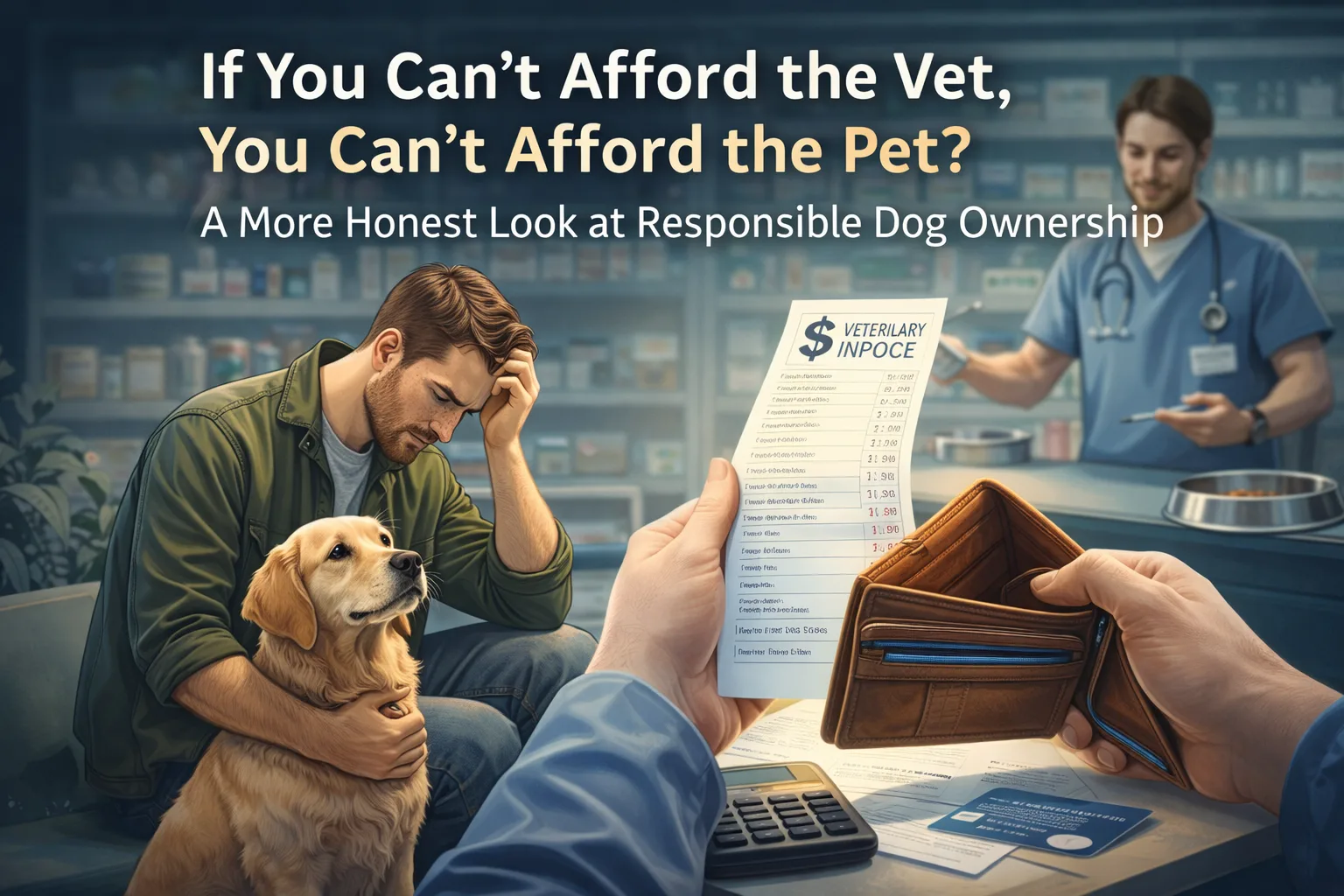
If You Can’t Afford the Vet, You Can’t Afford the Pet? Not So Fast.
Responsible dog ownership is not measured by a perfect bank balance. It is a practical plan for care, honest choices, and knowing where to ask for help.
Responsible dog ownership starts with a workable care plan
First, focus on the next useful step. Then, speak openly with your vet about costs, priorities, and safer alternatives.
Routine care should be planned for. But a sudden, life-changing vet bill does not automatically make someone a bad pet owner.
I’ve been seeing this phrase everywhere lately, and the more I hear it, the more I think it needs context.
There’s a line that gets repeated constantly in pet spaces: “If you can’t afford the vet, you can’t afford the pet.” On the surface, it sounds sensible. Even responsible. And to a point, it is.
If someone brings home a dog without budgeting for vaccines, food, flea and tick prevention, routine checkups, or the most basic supplies, then yes—there is a real problem there. Pets need more than love. They need ongoing care, and that care costs money.
But where this phrase starts to lose its shape is when people use it like a weapon. A dog gets poisoned. A young puppy develops a serious orthopedic issue. A healthy pet suddenly ends up needing emergency treatment that costs more than rent, a semester of school, or a used car. And instead of support, the owner gets shamed.
Being prepared for a dog is not the same thing as being financially invincible.
Responsible ownership should mean planning—not unlimited wealth.
A good owner should absolutely prepare for the predictable. That part is non-negotiable. Before bringing a dog home, there should be a plan for the basics and at least some room for the unexpected.
What responsible planning usually includes
- routine veterinary visits and vaccinations
- spay or neuter surgery
- flea, tick, and heartworm prevention
- quality food and basic supplements if needed
- crate, leash, collar, bedding, and toys
- grooming and hygiene tools like brushes, shampoo, nail clippers, or dental care items
- some emergency savings, even if it is modest at first
That is what thoughtful preparation looks like. It is practical. It is realistic. And for many families, it is already a serious commitment.
What it does not mean is that every decent owner should be able to pull out $8,000, $10,000, or $15,000 at a moment’s notice without blinking. That is not a moral standard. That is financial fantasy dressed up as ethics.
Some medical problems are simply bigger than people planned for.
This is the part online pet communities often skip. Not every major diagnosis arrives after years of neglect. Not every expensive surgery is the result of a careless decision. Sometimes the worst-case scenario just happens.
A very young dog can show signs of hip dysplasia earlier than expected. A dog can tear a ligament. A pet can swallow something dangerous, suffer an accident, or be harmed by someone else’s irresponsibility. None of those situations become less painful just because strangers on the internet decided the owner should have had unlimited backup money.
There is a world of difference between “I never planned for routine care” and “I never imagined a devastating specialist bill this early.” Those are not the same situation, and they should not be judged as if they are.
The internet loves simple rules. Real life is messier than that.
The reason this phrase spreads so easily is because it sounds clean. It gives people a tidy rule to repeat. But real pet ownership is rarely tidy.
A teenager who saved carefully for food, vaccines, preventives, checkups, and daily care may still be crushed by an advanced orthopedic recommendation. A family doing everything right may still have to choose between imperfect options. An owner can be deeply attached, deeply responsible, and still be in over their head when a catastrophic diagnosis lands without warning.
That truth makes people uncomfortable, because it forces us to admit something we do not like admitting: love and responsibility do not guarantee financial control over every outcome.
So what does “being able to afford a dog” actually mean?
A better question is not whether someone can pay for literally anything. A better question is whether they can provide a stable, healthy, decent life and make thoughtful choices when things go wrong.
A realistic standard
Can you cover routine care, food, prevention, basic supplies, and regular health needs without falling apart every month?
A responsible next step
Have you thought about emergency savings, financing options, pet insurance, or what you would do if a specialist referral ever became necessary?
That is a much more honest version of the affordability conversation. It leaves room for responsibility without pretending people must be wealthy to love an animal well.
Pet insurance matters. But it is not a magic solution.
It is fair to say that pet insurance can help. In many cases, it can be the difference between manageable treatment and financial panic. It is also fair to say that people should look into it early, before age-related issues or pre-existing conditions complicate the picture.
But insurance is not perfect. Policies differ. Coverage limits differ. Reimbursement can still leave families paying large sums up front. Some people discover the gaps only after they need help most.
So yes, insurance is worth considering. Strongly. But no, a lack of insurance does not automatically mean someone never should have had a dog.
What good pet communities should say instead
When someone is already scared, guilty, and trying to make sense of a huge medical decision, the last thing they need is a lecture disguised as virtue.
A better response sounds more like this:
- Ask the vet for a written treatment estimate.
- Find out whether there are non-surgical or staged options.
- Ask what is urgent and what can be monitored for now.
- Discuss pain management, mobility support, rehab, or lifestyle changes.
- Look into payment plans, specialist referrals, or second opinions where appropriate.
- Help the owner think clearly instead of making them feel smaller.
That is what support looks like. Not blind optimism. Not fake comfort. Just useful, steady help.
The line needs nuance—and frankly, a little more compassion.
The original phrase is not totally wrong. It does contain an important warning: pets are expensive, and nobody should bring one home assuming love alone will carry the whole responsibility.
But the phrase becomes unfair when people stretch it into something harsher: that every good owner must be able to absorb any bill, any time, for any amount, or else they never deserved their pet in the first place.
That idea is not wisdom. It is posturing.
Real responsibility is quieter than that. It looks like regular care. Preventive care. Paying attention. Asking questions early. Doing your homework. Making room in your budget where you can. And when things go badly, it looks like trying—seriously trying—to make the best decision possible for the animal in front of you.
A person can be a loving, prepared, responsible pet owner and still be devastated by a rare, expensive, life-altering diagnosis. Those things can exist at the same time. They often do.
Maybe the better standard is not “Could you pay any number under pressure?” but “Did you show up for your dog with care, consistency, and honesty?”
That is a much harder question. And also a much more human one.
Frequently asked questions
Does responsible pet ownership mean being able to afford every possible treatment?
No. It means being prepared for routine care, preventive care, and having some plan for emergencies. It does not mean every owner can instantly pay for every extreme or specialist-level medical bill.
Should I get pet insurance for my dog?
In many cases, yes—it is worth looking into early. But insurance varies a lot by policy, reimbursement structure, waiting period, and exclusions, so it should be part of a plan, not treated like a perfect safety net.
What should I budget before getting a dog?
At minimum: food, routine vet visits, vaccines, parasite prevention, basic supplies, grooming or hygiene care, and an emergency cushion. The exact number will vary, but going in without a plan is where real trouble starts.