
Dog Behavior · IPAWLIO Journal
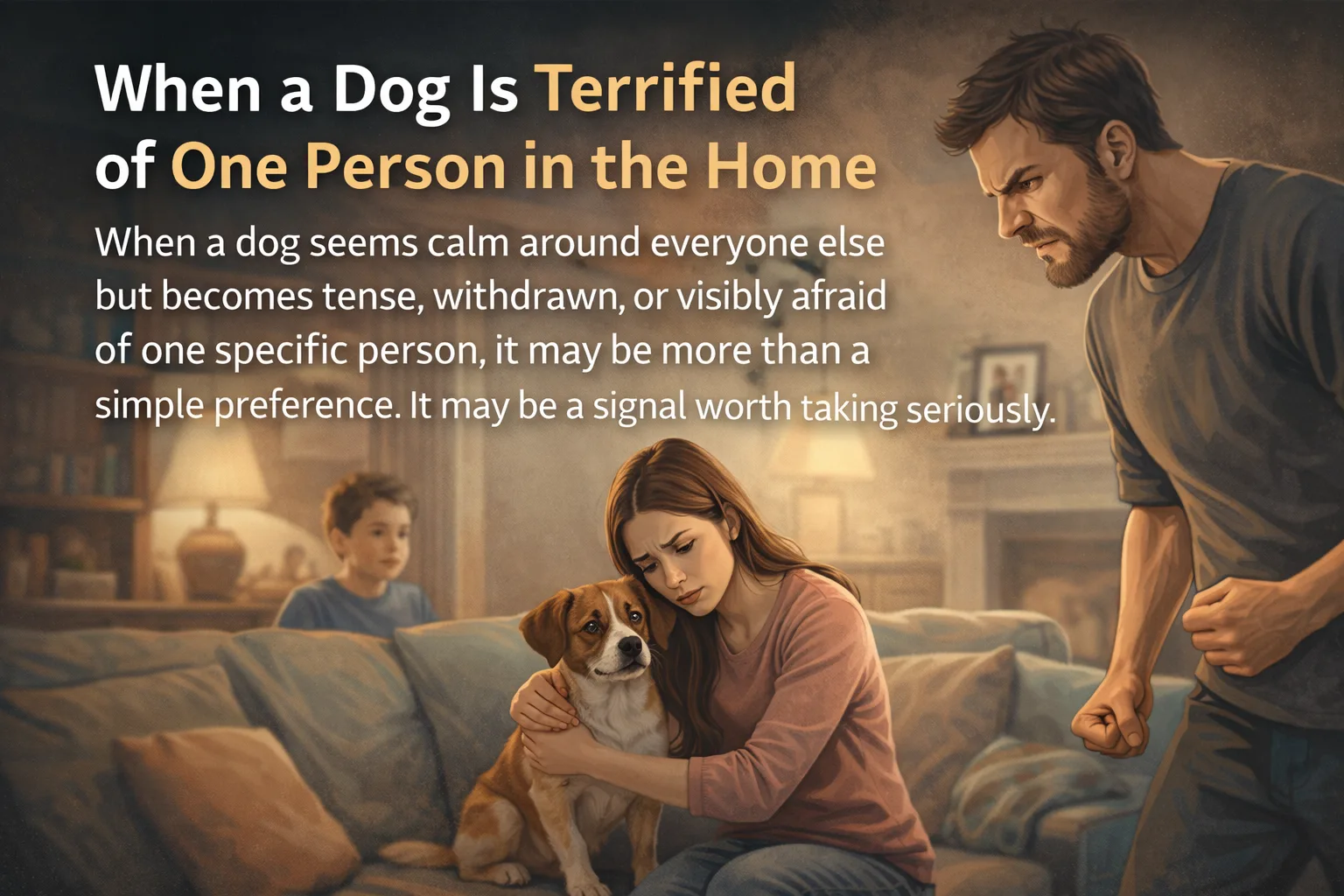
When a Dog Is Terrified of One Person in the Home
When a dog is afraid of one person, the fear can feel personal. However, the cause may be a sound, movement, scent, past experience, or a pattern nobody has noticed yet.
Why a dog may be afraid of one person
Start with distance and choice. Next, watch for the exact moment your dog becomes tense, and avoid forcing contact.
A dog afraid of one person needs patience, a predictable routine, and the freedom to step away.
When a dog seems calm around everyone else but becomes tense, withdrawn, or visibly afraid of one specific person, it may be more than a simple preference. It may be a signal worth taking seriously.
Some stories stay with you because they touch a nerve pet owners know too well: the moment you realize your dog does not just “dislike” someone — she seems genuinely afraid of them.
In situations like this, the behavior is often easy to minimize at first. Maybe she is shy. Maybe she just needs more time. Maybe that is simply her personality. But when a dog is relaxed around most of the family and repeatedly becomes distressed around one specific person, that pattern deserves attention.
Dogs do not explain fear in words. They explain it in body language, routine changes, and silence. IPAWLIO Editorial Note
Fear is not the same as preference
Some dogs have favorites. Fear looks different.
Dogs, like people, have preferences. Some bond more strongly with the person who feeds them, walks them, or spends the most time playing with them. That is normal.
Fear is something else entirely. A fearful dog may freeze, lower her body, avoid eye contact, retreat, tremble, tuck her tail, lip lick, yawn excessively, or try to make herself small. Some dogs become hypervigilant. Others shut down. A few may become defensive if they feel cornered.
That is not the same as “she just likes me more.” If the same stress signals appear consistently around one specific person, it is worth taking seriously.
Possible causes
Why a dog may fear one person in the home
There is not always one simple explanation, and it is important not to jump to conclusions too quickly. But there are several reasons a dog may become fearful of one person in particular.
Past trauma or negative associations
A dog’s fear may be shaped by earlier experiences. A person’s voice, scent, body language, size, or energy can remind a dog of someone who frightened her before.
Harsh handling or intimidation
Fear does not always require physical harm. Repeated yelling, looming, rough corrections, cornering, or unpredictable anger can create deep stress very quickly.
Inconsistent behavior
A person who feels calm one moment and explosive the next can feel unsafe to a dog. Dogs rely heavily on predictability and readable patterns.
Poor respect for boundaries
Some people push interaction, stare too long, grab, tease, or ignore subtle signs of discomfort. Over time, the dog may learn that proximity means stress.
A highly sensitive temperament
Some dogs are especially reactive to tension, loud voices, sudden movement, or emotional conflict in the home. Even without obvious harm, the dog may still feel unsafe.
A pattern the humans have normalized
Sometimes the hardest part is not the behavior itself, but how easily people begin explaining it away. Repetition can make a serious pattern look ordinary.
A red flag worth noticing
When fear starts to feel like a warning sign
One of the most striking things about these situations is how often owners try to rationalize them in the beginning. Maybe she is nervous. Maybe she needs more exposure. Maybe it will pass.
Sometimes it does. But when a dog who is otherwise affectionate, social, and comfortable becomes visibly distressed around only one person, it is reasonable to pause and ask harder questions.
Dogs are not reading résumés. They are reading tone, pressure, movement, tension, and emotional safety. They often notice what we miss, and they often react before we are ready to name what feels wrong.
What to watch for
Signs the situation should not be dismissed
- Your dog becomes tense the moment that person enters the room
- She avoids shared spaces when that person is nearby
- She flinches at their voice, footsteps, or hand movement
- She hides, lowers her body, or seems unable to settle
- She appears relaxed with everyone else
- The pattern is consistent, not occasional
- Her body language signals stress rather than simple disinterest
The more specific and repeatable the pattern, the harder it becomes to dismiss it as chance.
What not to do
Fear is not something to force through
When a dog is showing fear, the goal is not to make her “get over it.” Forced closeness often deepens anxiety rather than resolving it.
- Forcing interaction
- Trapping her in the same room
- Punishing avoidance or growling
- Handing her over to the person she fears
What looks like stubbornness is often self-protection. A fearful dog needs distance, predictability, and the ability to create space.
A calmer next step
What you can do right now
Give her distance
Use gates, quiet corners, separate rooms, or any other safe setup that allows the dog to avoid unwanted contact.
Watch body language closely
Look for tension, scanning, freezing, tucked posture, avoidance, and other signals that show the dog does not feel at ease.
Document the pattern
A simple note on your phone can help. When did it happen? Who was there? What exactly did the dog do?
Protect routine and calm
Consistent walks, feeding, sleep, and decompression time help regulate stress in dogs living with chronic tension.
Speak with a professional
A veterinarian or qualified force-free behavior professional can help assess whether the fear is trauma-related, environmental, or part of a larger anxiety picture.
Take the behavior seriously
Even if you do not yet know the full reason, repeated fear is real. It should not be brushed off because it is inconvenient to face.
The difficult question
Sometimes the dog is reacting to more than we want to admit.
In homes where fear becomes chronic, the most painful question is often not, “What is wrong with the dog?” but, “What is this dog responding to that I may not be fully seeing?”
That question can be emotionally hard, especially when relationships, family roles, and children are involved. But protecting a dog sometimes means being honest about what her body language is trying to communicate.
If she is consistently afraid, that fear is real — whether or not the people around her want to minimize it.
A painful but honest possibility
Is rehoming ever the kinder choice?
Rehoming is often discussed too casually, but in some situations it becomes a deeply compassionate decision. Not because the dog is disposable, but because chronic fear is not a small thing to ask an animal to live with.
If a home cannot become emotionally safe for the dog, then a quieter and more trustworthy environment may be kinder than asking her to endure daily stress. Rehoming should not be the first reflex, but neither should keeping a dog in a situation that is clearly breaking her sense of safety.
Final thought
Dogs deserve more than basic survival.
Food, water, shelter, and veterinary care matter. But emotional safety matters too. A dog who spends her days bracing, shrinking, or scanning the room for one person’s presence is not truly at ease.
If your dog is terrified of one person in the home, do not dismiss it as drama, stubbornness, or “just how she is.” A fearful dog is telling you something important. Her fear deserves respect.
Because love is not just keeping a dog. Sometimes love is noticing when she no longer feels safe — and being brave enough to act on that truth.
FAQ
Common questions owners ask
Why is my dog scared of only one person?
A dog may fear one person because of past trauma, negative associations, harsh handling, loud energy, unpredictable behavior, or repeated discomfort around that individual.
Can a dog become afraid without physical abuse?
Yes. Repeated yelling, intimidation, rough handling, emotional unpredictability, and ignored boundaries can all create real fear in a dog.
Should I force my dog to spend time with the person she fears?
No. Forced interaction often increases stress and damages trust. Fear-based behavior usually improves with safety, distance, and calm structure.
When should I get professional help?
If the fear is intense, repeated, worsening, or affecting the dog’s daily well-being, it is a good idea to speak with a veterinarian or a qualified behavior professional.
Is rehoming always wrong?
Not always. In some situations, especially when a dog cannot live safely and calmly in the current home, rehoming may be the more compassionate option.
Editorial note: This article is intended for educational discussion and does not diagnose any person or situation. If a dog is showing ongoing fear in the home, the priority should be safety, careful observation, and appropriate professional guidance where needed.