
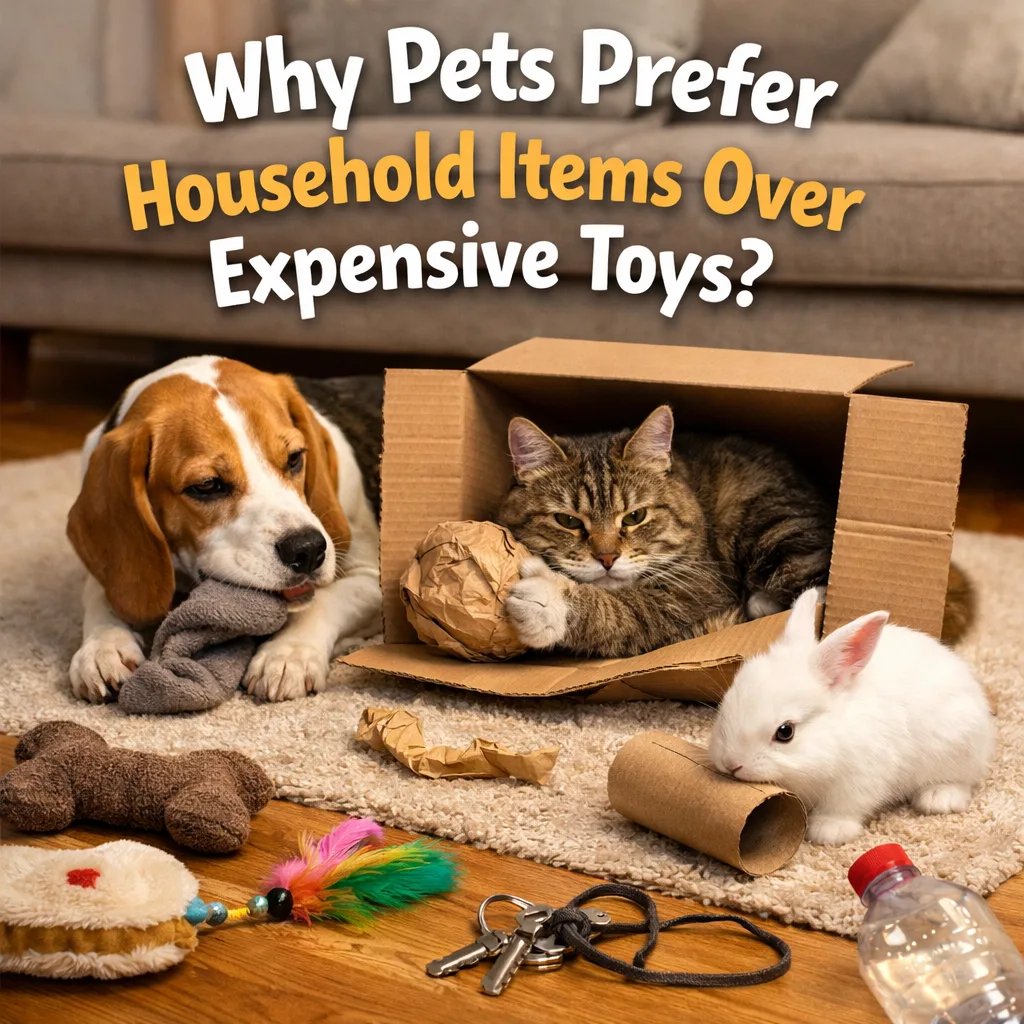
Why Pets Ignore Expensive Toys and Fall in Love With Random Objects
You choose the toy with care. They walk past it and claim the cardboard box, the old sock, or the scrap of fabric on the floor instead. It feels funny at first, but it also reveals something deeply honest about how pets experience comfort, curiosity, and play.
There is a moment many pet owners know well: you bring home the toy that seemed like such a good idea, only to watch your pet lose interest almost instantly and become completely fascinated by something far less glamorous. A paper bag. A slipper. A worn corner of fabric. A simple cardboard box. Somehow, that becomes the object they care about most.
If this sounds familiar, you are in very good company. Across dogs, cats, rabbits, and other companion animals, pet owners notice the same small contradiction again and again. The thoughtfully chosen toy sits untouched, while the random everyday object becomes the one they carry, nap beside, chase across the room, or quietly guard like treasure.
From a human point of view, it feels irrational. From a pet’s point of view, it often makes perfect sense. Pets are not drawn to price, packaging, or presentation. They are drawn to what feels interesting, comforting, familiar, or alive in their own sensory world.
It is not just your pet. It is part of how many pets move through the world.
One of the quiet comforts of living with animals is discovering that the strange habit you thought belonged only to your pet is actually widely shared. Some animals become attached to one ruined plush for years. Some prefer the box a product arrived in more than the product itself. Some always want the one thing they were never technically given.
What looks random to us is often not random at all. Their choices may be shaped by scent, softness, sound, texture, movement, memory, or simply the thrill of novelty. A household item might feel more emotionally relevant than a brand-new toy because, in their world, relevance is sensory before it is visual.
Pets do not choose based on price or polish. They choose what feels right to them in the moment — what smells familiar, moves interestingly, or offers a kind of comfort we do not always notice at first glance.
Why random objects can feel more compelling than toys
Familiar scent carries emotional weight
Pets experience the world through smell in a way humans never fully can. A sock, an old T-shirt, a blanket corner, or a slipper often carries the scent of home and the scent of the people they love. That alone can make it feel more meaningful than something new that smells like packaging, shelves, or storage.
Texture may matter more than clever design
Crinkly paper, soft fleece, rough rope, bendable rubber, and light cardboard all create different kinds of sensory feedback. Sometimes an ordinary object is not more beautiful or better made. It simply feels better to mouth, paw, scratch, toss, or carry.
Unpredictable movement sparks instinct
A paper ball slides differently each time. A loose ribbon shifts in a way that feels alive. A bottle cap rolls at uneven angles. These imperfect movements can be more exciting than toys that behave too predictably. To many pets, surprise is part of the pleasure.
Novelty changes attention
A newly discovered object on the floor can feel instantly more interesting than something that has been sitting in the same toy basket for weeks. Sometimes the appeal is not only the item itself, but the feeling of discovery that comes with it.
Sometimes the favorite object is not about play at all
Not every beloved object is chosen because it is stimulating. Some are chosen because they are calming. A dog may sleep beside an old plush that has long lost its original shape. A cat may keep returning to one soft piece of fabric. A rabbit may settle near a familiar item after a burst of energy through the room.
In these cases, the object becomes part of an emotional routine. It feels known. It smells right. It belongs to the rhythm of home. This matters because pet essentials are not only about activity or entertainment. Often, they are also about reassurance, rest, and the quiet stability of familiarity.
What this tells us about choosing better toys
The lesson is not that toys do not matter. It is that the right toys should feel relevant in a pet’s actual life. A product may look beautiful on a page, but pets do not live on product pages. They live in rooms, routines, moods, habits, and small daily rituals.
- Textures they naturally enjoy returning to
- Shapes that are easy to carry, nudge, paw, or chase
- Materials that feel satisfying without being harsh
- Movement that invites curiosity instead of forcing it
- Design that suits a pet’s size, habits, and energy level
- Construction that feels safer and more dependable for real daily use
The goal is not to overwhelm pets with more things. More often, it is to give them fewer, better-chosen ones. Thoughtful design matters most when it meets real behavior, not just visual expectation.
Why expensive does not always mean more loved
Many pet owners eventually learn the same quiet truth: cost and attachment are not the same thing. A pet may ignore a high-priced toy and adore a very simple one. That does not automatically mean the more expensive item was poor. It may simply mean it did not match what that animal instinctively enjoys.
Some pets love soft comfort objects. Some want bounce and chase. Some prefer tug textures. Some only become interested when a human joins in. Their preferences are often highly specific, and that specificity deserves more attention than trend lists or impulse buys.
The better question is rarely “What is the fanciest toy?” It is usually “What kind of interaction does my pet naturally return to, again and again?”
A better way to keep pets interested without buying endlessly
If your pet often ignores toys, the answer is not always more quantity. Sometimes it helps far more to change the rhythm around what they already have.
Rotate instead of displaying everything at once
When every toy is always visible, they can fade into the background. Rotation helps certain items feel fresh again without adding clutter.
Match the item to the mood
A playful afternoon, a quiet solo hour, and a calm bedtime routine all ask for different types of engagement. Not every object has to serve the same purpose.
Pay close attention to repeat behavior
What they carry, chase, chew, scratch, or nap beside tells you more than any product trend. Their own patterns are the clearest guide you have.
The safety side still matters, even when the habit is funny
There is an important reminder hidden inside this charming behavior: not every object a pet loves is safe for regular play. Socks, strings, damaged household items, small plastic pieces, loose fabric scraps, or sharp-edged packaging can all create risks depending on the pet and the way they interact with it.
That is why these preferences are useful to observe, but not always useful to encourage without limits. If your pet clearly loves a certain texture or shape, it is often better to look for a safer alternative designed for that kind of interaction. They still get the satisfaction they enjoy, but with fewer trade-offs.
Maybe they are not being difficult. Maybe they are simply being honest.
There is something endearing about the way pets choose what they love. They are not influenced by branding. They are not trying to validate our shopping decisions. If something feels comforting, engaging, or alive to them, they go back to it. If it does not, they move on without apology.
In that sense, pets are surprisingly honest. They remind us that joy, usefulness, and attachment do not always look the way we expect. And for those of us trying to choose better things for them, that honesty is worth listening to.
At IPAWLIO, we believe pet essentials should feel grounded in real life — not only attractive on a screen, but genuinely suited to everyday routines, real homes, and the animals who make those homes feel fuller.
Common questions pet owners ask
Why does my pet prefer random household objects over new toys?
Pets often respond more strongly to scent, texture, movement, familiarity, and novelty than to appearance or price. A household object may simply feel more interesting or more comforting in their world.
Is it normal for pets to ignore new toys at first?
Yes. Some pets need time to adjust to new smells, textures, or play styles. Others only engage when a toy matches a behavior they already enjoy, such as chewing, chasing, carrying, or nesting.
Should I let my pet play with socks, cardboard, or random objects?
It depends on the item and the pet, but many household objects can pose risks if swallowed, torn apart, or chewed too aggressively. Supervision matters, and safer alternatives are usually better for long-term use.
How can I choose toys my pet will actually use?
Start by noticing patterns. Watch what your pet carries, chases, chews, paws at, or rests near. Their natural preferences usually tell you far more than what looks appealing to us.
Is rotating toys better than leaving them all out?
For many pets, yes. Rotation can make familiar toys feel interesting again and can reduce the sense that everything in the basket has become background clutter.